
Moss Stitch Crochet Blanket: Easy Step by Step Pattern
Table of Contents
A moss stitch crochet blanket is an approachable, textured project built from single crochet and chain spaces, and it suits beginners who can keep track of repeated rows. The steady rhythm can make crocheting feel calm and rewarding, even when you only have time for a few rows at once. You can work the texture in stripes or keep the whole blanket one color.
Patterns may use different starting-chain rules and first-row steps, so reading those directions before you begin helps prevent confusion. A small test piece also lets you see how your yarn and hook shape the fabric. A small gauge swatch is the simplest way to check the fabric before committing to a full-size project.
How to Make a Moss Stitch Crochet Blanket
The moss stitch repeats single crochet and chain spaces, so you can learn its basic rhythm with a short swatch before beginning a blanket. A chain-1 space is the small opening made by a chain stitch between single crochet stitches. The stitch uses basic single crochet and chains, while careful row-end counting helps keep your sides straight.
A moss stitch crochet blanket for beginners can start with either an odd or even number of chains, depending on the pattern. The odd-chain method begins with single crochet across its first row. Its next row alternates single crochet, chain 1, and skipping a stitch. On later rows, place each single crochet into the chain-1 space below.
The even-chain method uses a different foundation and first-row setup. A moss stitch crochet written pattern should state its starting chain and turning instructions. Those small details matter, because the chain count affects how the edge repeat begins and ends.
Follow one pattern’s foundation and turning instructions consistently rather than switching methods midway through the first row.
After the first row, read each instruction from the stitch you can see. When the pattern says to work into a chain-1 space, insert the hook into the opening rather than into the top loops of a stitch. Keep the skipped stitch clear in your mind, since it creates the small gaps that shape the fabric.
The stitch also goes by granite stitch, linen stitch, seed stitch, and woven stitch. Those names may appear in books or online patterns, but the written directions still guide your work. A short swatch gives you room to practice the repeat and spot missed spaces before they affect a large piece.
This texture can also form a square in continuous rounds, with corner spaces that shape each turn. That version continues around the square without joining each round, unlike a flat-row blanket. A sample worked in Caron Big Cakes measures 25 in x 25 in after one ball, or 32 in x 32 in after about 1.5 balls.
For other beginner-friendly stitch ideas, browse these easy crochet stitches for blankets. A few practice rows will help you recognize where the next single crochet belongs. Once the gap and stitch pattern feel clear, you can follow the written directions at a steady pace.
Choose Your Yarn, Hook, and Blanket Size
Choose the finished dimensions first, because width sets the starting-chain plan and height determines how long you repeat the body rows. A 40 in x 53 in throw, a 32 in x 32 in baby blanket, and a 30 in x 36 in throw offer useful examples. Treat those sizes as models, not fixed rules for every blanket.
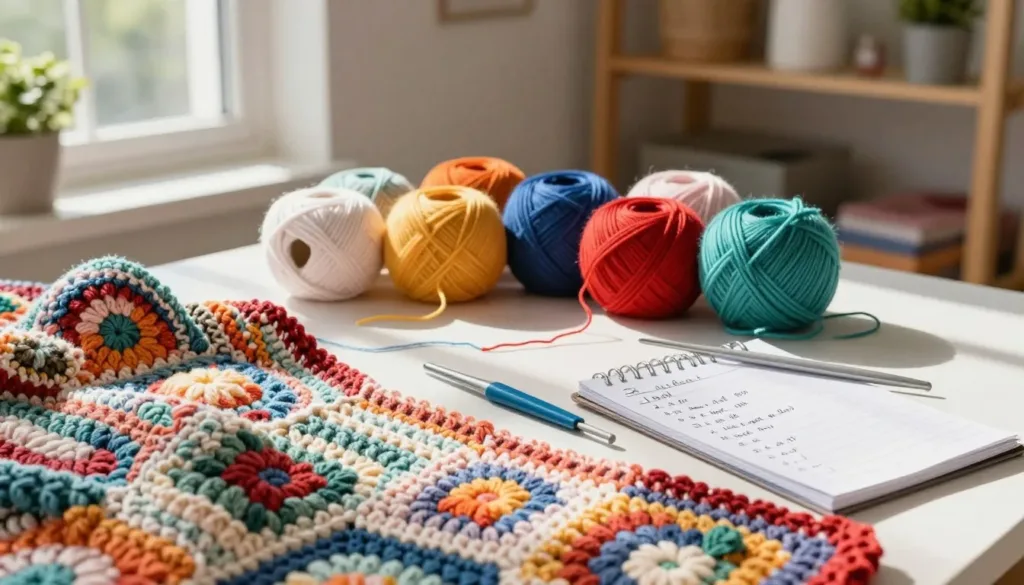
A sample’s gauge tells you how many stitches and rows fit within a set space. Matching that gauge helps you reach a similar finished size, while your hook and tension change the fabric’s density and drape. A larger hook than the yarn label suggests makes a more open fabric; tighter work creates a denser texture.
- Set the finished width and height before planning the starting chain.
- Choose yarn weight and fiber for the feel and care the blanket needs.
- Pick a solid color, stripes, or a mix of colors for the design.
- Choose a hook, then make a gauge swatch with that yarn.
The Modern Moss Stitch Blanket measures 40 in x 53 in and uses two skeins of White and one skein of Black Caron One Pound yarn. Its gauge is 4 in = 8 stitches and 14 pattern rows. Those figures can help you compare your swatch with a finished sample.
The Moss Stitch Baby Blanket measures 32 in (81 cm) high by 32 in (81 cm) wide. It uses size 4, or medium, yarn; a listed sample skein of Lion Brand Pound of Love is 16 oz / 454 g and 1,020 yds / 932 m. Its gauge is 4 in x 4 in = 8 stitches and 15 rows.
That baby blanket uses a K/10.5 (6.50 mm) body hook and an I/9 (5.25 mm) border hook. The baby blanket gauge and hook setup gives you a specific starting point, though your own tension may differ. The Craft Yarn Council’s yarn weight and hook size standards explain common label and hook terms.
The Cobblestone Pathways pictured throw measures 30 in x 36 in and uses about 1,000 yards of worsted-weight yarn. Its sample uses about 16 oz of Hobby Lobby I Love This Yarn in Linen, with J/10 (6 mm) and I/9 (5.5 mm) hooks. This is another example, not a required materials list.
For the baby blanket, adjust width with starting chains in multiples of 2+1, then add or reduce rows to change height. The yarn’s weight, your gauge, and the border’s depth all affect how much yarn you need. Measure the swatch after it rests flat so your size decision reflects the fabric you will actually make.
Work the Blanket Body Row by Row
Start with the foundation chain and first row specified for your chosen pattern, because moss stitch patterns do not all use the same chain convention. A free moss stitch crochet blanket pattern may use a plain one-color repeat or a planned stripe sequence. Use the chain count and first-row directions written for that specific pattern.
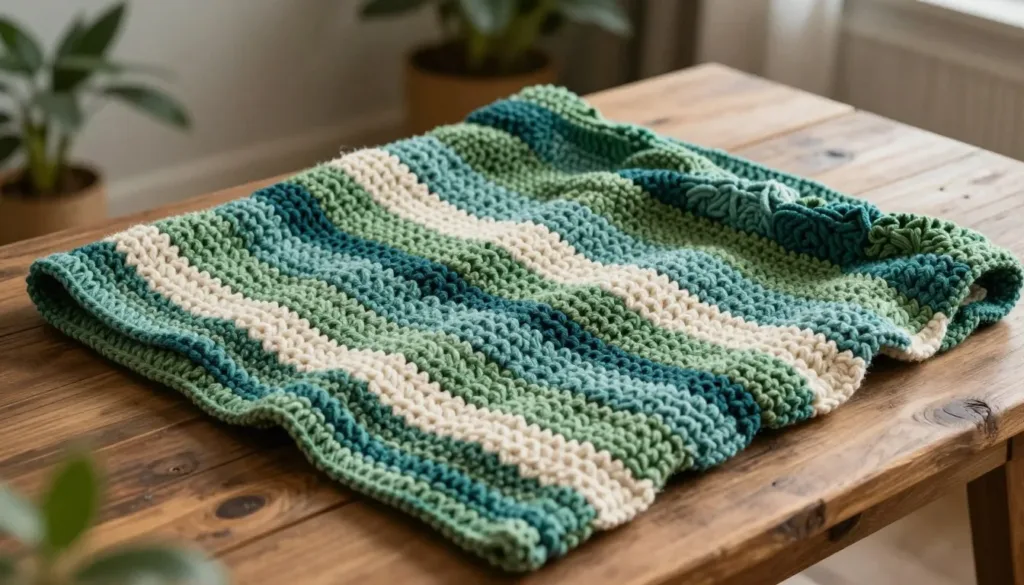
The Modern Moss Stitch Blanket begins with a chain of 150 and works over any even number. The baby blanket instead starts with a chain of 101 and has 100 single crochets in Row 1. Its width adjustment uses multiples of 2+1, so its setup differs from the Modern throw’s even chain.
- Choose the foundation-chain method named in your pattern.
- Work the foundation and first row exactly as directed.
- Repeat the moss stitch across each row and check the final space.
- Track your row count, then measure the blanket’s length as you go.
- Change color on the final stitch when your stripe plan calls for it.
On the Modern throw, the color sequence is 8 rows of White, 1 row of Black, 3 rows of White, then 1 row of Black. Repeat that sequence until the piece measures about 50 to 55 inches or reaches your chosen length. The Modern blanket’s stripe sequence is one example of a planned color pattern.
Shop Crochet Essentials
Explore useful tools, colorful yarn and books for your next project.
As an Amazon Associate, I earn from qualifying purchases.
To change colors, finish the last stitch in the old color until two loops remain on the hook. Use the new color to yarn over and pull through both loops. Turn, then chain 2 with the new color before continuing.
Moss stitch crochet blanket patterns can keep the same texture throughout or combine bands with other stitches. The Modern blanket uses repeated color bands over an all-over moss stitch body. Cobblestone Pathways starts with a chain of 97, one single-crochet foundation row, and 15 moss-stitch rows.
That throw then alternates 5 rows of double-crochet-two-together with 10 moss-stitch rows, before finishing with 15 moss-stitch rows. The baby blanket body reaches about 26 in (66 cm), estimated at about 94 rows. Row count can guide your progress, but it does not replace measuring the fabric.
When you change colors, check that the new shade sits neatly at the edge before working several rows. Keep a written tracker beside your project, especially when a pattern mixes stitch blocks and color bands. Measure the piece as you go and stop at your planned length rather than relying only on an estimated row count.
Add a Border and Finish the Blanket
Add the border only after checking that the body edges are even and the four corners are easy to identify. You can use two rounds of moss stitch, a deeper mixed-stitch edge, or another border that suits the fabric. Work evenly along the sides and shape each corner so the edge lies flat.
The Modern Moss Stitch Blanket uses two moss-stitch border rounds, with 3 single crochets in each corner. The baby blanket uses seven rounds: three rounds of single crochet, followed by four rounds that alternate single crochet and triple crochet. Its border uses a hook two sizes smaller than the body hook.
Cobblestone Pathways shapes each corner with single crochet, chain 2, single crochet. That corner treatment is one option, not a rule for every edge. On a four-sided piece, any stitch count can work around a moss-stitch border; an odd number per side is ideal, while an even count can be managed in the next round.
Check that each corner lies flat before you add more rounds; extra stitches can make an edge ruffle.
Along the sides, space border stitches evenly instead of forcing one stitch into every row. Row ends and stitch tops do not always line up in the same way. Pause at each corner, then use your chosen corner treatment before continuing along the next side.
A moss-stitch border can continue to the depth you want, and you can change yarn between rounds. Keep the new color secure at the edge, then weave in the ends with a yarn needle. Weaving in ends means passing each tail through nearby stitches so it stays in place.
Blocking can help square the blanket and smooth small bumps. Follow the yarn’s care label, then shape the damp fabric on a flat surface without stretching it out of proportion. A soft, washable yarn can be helpful for a baby blanket, where easy care matters.
Before the border dries, check the corners from above and from the side. Flat corners should not curl upward or flare outward, and the sides should not gather. Lay the finished piece flat and adjust the corners before the fabric dries if you block it.
Conclusion
A small swatch and a clear row count make this project easier to manage from the first chain to the final edge. The swatch helps you test the fabric, while a written tracker keeps stripe changes and repeated rows easy to follow. If you want another simple project after this one, explore beginner-friendly crochet patterns.
Pick one foundation-chain method and make a first test row before you start the full blanket. Note the gauge and how the fabric feels in your hands. Gather your yarn and hook, make the swatch, and note the gauge before starting the blanket.


