
Moss Stitch Crochet: Easy Pattern Steps for Beginners
Table of Contents
Moss stitch crochet is a beginner-friendly pattern that alternates single crochet stitches and chain spaces to make a textured fabric. That steady rhythm can turn a few simple stitches into something you’ll be glad to use or give. A chain-1 space is the opening made when you work a chain stitch between two crochet stitches.
The stitch is also called granite stitch, linen stitch, woven stitch, or seed stitch, though names for similar patterns can vary. Its woven-looking texture suits many projects, from dishcloths to baby items. You can find more beginner-friendly crochet ideas if you want to explore after your first swatch.
Basic chain and single crochet skills are enough to get started. You only need to know how to chain and single crochet before you begin.
How to Start Moss Stitch Crochet With a Foundation Chain
A ball of yarn, a matching hook, scissors, and a finishing needle are enough to get your first swatch started. Check the yarn label for a suitable hook, and use US crochet terms for these instructions. One choice matters before you chain: some moss stitch methods use an odd count, while others use an even count.
Follow the foundation chain stated in the version you chose. A basic crochet kit needs only these supplies:
- Yarn in a weight that suits your project
- A hook that matches the yarn label
- Scissors for cutting the yarn
- A finishing needle for weaving in yarn tails
Pick one foundation-chain method and keep its instructions nearby. Switching between odd- and even-chain methods can change where the first row begins.
For a quick practice swatch, one tutorial pairs size 6 super bulky yarn with an M/9 (9.00 mm) hook. Your yarn label can help you choose a hook for different yarn. The Craft Yarn Council standards include yarn labels, crochet abbreviations, chart symbols, and hook-size references.
A beginner crochet site can also help you find simple patterns for practice. Keep the chosen foundation-chain method beside your work so you do not switch methods halfway through.
The Basic Moss Stitch Crochet Pattern, Row by Row
In the odd-chain version, chain 13 gives you 12 pattern stitches when you count both the single crochets and chain-1 spaces. The starting chain is a multiple of 2 plus 1, and the first row creates the spaces used later. Count the spaces as pattern stitches, even though they are openings.
For Row 1, skip two chains, then alternate single crochet, chain 1, and skip 1 across. Treat the two skipped chains at the start as the first chain-1 space. End with a single crochet in the final chain.
For Row 2, chain 2; this counts as a chain-1 space and a single crochet. Work a single crochet into the next chain-1 space. Then repeat chain 1, skip the next single crochet, and single crochet in the next chain-1 space.
Repeat Row 2 for the remaining rows. The moss stitch is reversible, so both sides show the same basic texture. You can also read the pattern as a diagram: symbols show the stitches, while the gaps between them mark chain-1 spaces.
A blanket stitch guide can help you compare this pattern with other easy crochet stitches. The chain 13 example makes it easier to see how the openings count across the row. Check that each new single crochet lands in a chain-1 space rather than in the stitch beside it.
Odd- and Even-Chain Moss Stitch Variations
Both odd- and even-chain foundations work, but each belongs to a different written method. You need an odd or even starting count based on the pattern you follow, not a universal moss stitch rule. The name can cover different stitch sequences, so check the setup before you begin. These options show how the methods differ:
- Odd-chain setup: Start with an odd number of chains. Work single crochet across Row 1, then use chain 1, skip 1, and single crochet across Row 2. From Row 3 onward, place single crochet in chain spaces.
- Even Moss Stitch: Start with an even number of chains. Alternate slip stitch and half double crochet, turn with chain 1, and repeat Row 2 while matching each stitch type.
- Two-row even-chain method: Start with an even chain count. Row 1 begins with single crochet in the second chain from the hook and makes half as many single crochets as the starting count, plus one. Repeat Rows 2 and 3.
- Fourth-chain method: Start with a multiple of 2. Put the first single crochet in the fourth chain from the hook, then use chain 2 at later row starts. Repeat Row 2 and end between the turning chain and the prior row’s single crochet.
The Even Moss Stitch method shows why stitch names do not always point to one exact setup. Follow the turning-chain and edge instructions of the version you chose, since those details keep its sides even.
Adjusting Gauge, Hook, and Fabric Feel
If your swatch feels too firm or too open, adjust the hook before changing the stitch pattern. Yarn weight, hook size, and your personal tension all affect the fabric’s feel and size. Start with a swatch in the yarn you plan to use, then check its texture, stitch count, and row count.
A smaller hook makes denser, stiffer fabric, while a larger hook gives the stitches more drape. A gauge check often uses a 4-by-4-inch area. Count the stitches and rows inside that area, then compare the result with the pattern’s gauge.
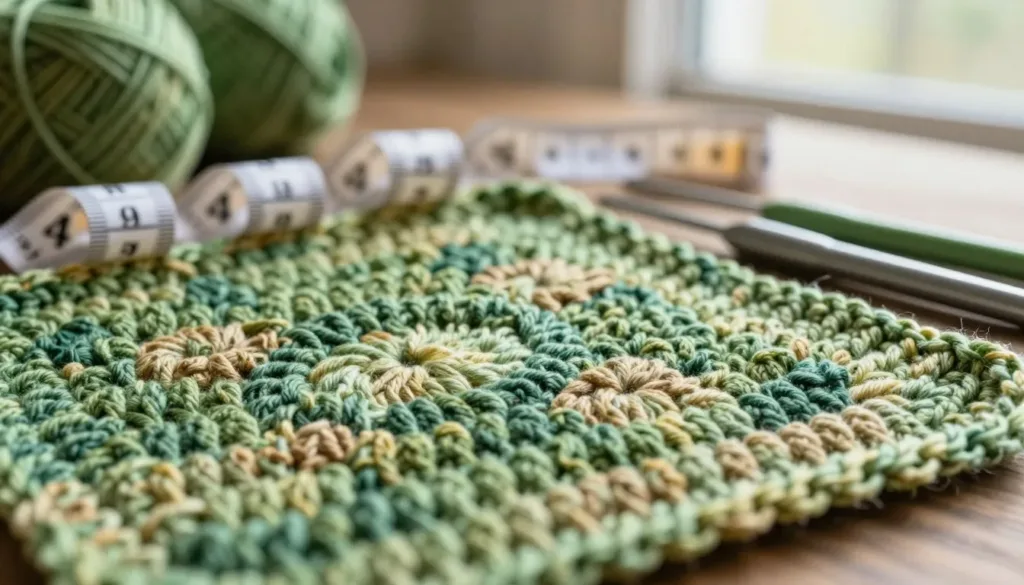
If the fabric feels right but your counts differ, note both results before you change anything. A hook change affects more than texture: it can also alter the finished dimensions. Recheck the swatch before making a full blanket, scarf, or other project.
The Craft Yarn Council’s crochet standards and reference charts cover yarn weights and hook sizes. The Crochet Guild of America describes gauge and stitch work in its crochet mastery programs, including its Fundamentals of Crochet and Advanced Stitches and Techniques curricula.
Keep notes on the yarn, hook, and swatch measurements so you can match the fabric later. Measure the swatch after it has settled, then use that same yarn and hook for the project.
Changing Colors and Using Visual Aids
For a clean moss stitch color change, complete the last stitch of the row with the new color before you turn. When two loops remain on the hook, pull the contrast color through both loops. The change happens at the end of the old row, so the next row starts in the new shade.
Pull the new color through the final stitch’s two remaining loops before turning. This places the new yarn at the top of the row rather than adding it after the turn. If you change colors at a different point, the edge can look uneven.
After the change, keep the old tail on the wrong side of the fabric. Leave enough length to weave it in with a finishing needle. A few secure passes through nearby stitches help hold the tail without pulling the edge out of shape.
A stitch diagram can help when chain spaces are hard to spot in a textured row. Look for the openings between stitches, rather than treating each opening as a single crochet. A video can show the hand movement and where the hook enters each space.
Some tutorials offer separate videos for right-handed and left-handed crocheters. Choose the view that matches how you hold your hook, then pause at the row edge if you lose track of the repeat. Keep the yarn tails on the wrong side and weave them in securely when the color section is finished.
Sizing Moss Stitch Blankets and Scarves
A moss stitch blanket or scarf is easiest to size after you make a gauge swatch in the yarn and hook you plan to use. Use the swatch to compare your stitch and row counts with the pattern. These examples show how yarn, color, hook, and measurements can vary by project. Check each pattern’s gauge before scaling up.
- Blanket: A Caron One Pound project uses a J/6.0 mm hook and an even-numbered starting chain of 150. Its base chain is 2 inches wider than the desired blanket because Row 1 reduces the width by about 2 inches. The finished blanket measures 40 by 53 inches, with a gauge of 8 stitches and 14 rows per 4 inches. It uses two skeins of white and one skein of black, in a sequence of 8 white rows, 1 black row, 3 white rows, and 1 black row.
- Regular scarf: The scarf measures about 70 by 6.25 inches, without tassels. It uses size 4 medium yarn in two colors, an I/9 (5.50 mm) hook for starting rows, and a J/10 (6.00 mm) hook for the remaining rows. Gauge is 8 single crochet stitches and 17 pattern rows per 4-by-4-inch swatch, excluding chains and spaces. Plan about 275 yards of Color A and 255 yards of Color B.
- Large scarf: The scarf measures about 80 by 7.5 inches, without tassels. It uses the same yarn weight and hook sizes as the regular scarf. Plan about 295 yards of Color A and 275 yards of Color B.
The blanket gauge and size show how a pattern’s starting chain can account for a narrower first row. For the scarf, adjust length by changing the starting chain in multiples of 2 plus 1; change width by working more or fewer rows.
Moss stitch also works well for dishcloths and baby blankets, where a textured fabric can suit daily use. Browse crochet project ideas for other beginner-friendly projects. Measure scarf length without tassels so the finished size matches the pattern’s stated dimensions.
Extended Moss Stitch and Other Related Patterns
Extended moss stitch changes the texture by working a longer stitch down into a stitch two rows below. Specifically, it uses US double crochet around the chain space and into the skipped stitch. This longer stitch adds height without making it the same pattern as classic moss stitch. Related patterns also use their own setups and repeats.
The extended version starts with a multiple of 2 plus 1 and repeats Rows 3 and 4. One sample uses Stylecraft Bellissima double-knit yarn, 268 m per 100 g, with a 4.5 mm/G+ hook. A different extended moss stitch scarf uses worsted weight (#4) yarn, an I-9 (5.5 mm) hook, and about 300 yards. It measures about 4.5 inches wide by 60 inches long, with a gauge of about 17 stitches by 14 rows per 4 inches.
Leaning moss stitch has an odd-chain setup, such as 29 chains for a scarf, and repeats Rows 3 and 4. Its sample uses a 5 mm/H/8 hook, and a printable diagram can help show its stitch placement.
Soft Moss Stitch starts with a chain multiple of 2 plus 1. It works single crochet into the third chain, then alternates double and single crochet, ending with half double crochet. Its repeat starts with chain 2 and alternates into the opposite stitch type; Silt Stitch stacks the stitch types instead.
Drunken granny crochet stitch is a separate texture pattern, not another name for basic moss stitch. It starts with a chain multiple of 5 plus 4, then repeats Row 3 after its setup rows. One sample uses Sheepjes Stone Washed XL yarn and a 5 mm hook, though other yarn and hook sizes can work.
Check the repeat and stitch placement before treating a related pattern as classic moss stitch. Similar names do not guarantee the same fabric or setup.
Swatch a related pattern before committing to a larger project, since its repeat and stitch placement may differ from the basic version.
Conclusion
A steady repeat of single crochet and chain spaces is all you need to build the fabric. The recognizable texture comes from placing each single crochet into the chain-1 space, not into the stitch beside it. That small detail keeps the rows aligned.
You can test the feel and look of the fabric on a small swatch before choosing a larger project. A simple square also gives you a chance to practice keeping the same rhythm across each row. Pick a yarn and hook you already have, make a small swatch, and choose your next project from the fabric it creates.
FAQ
How to do moss stitch crochet step by step?
Is moss stitch a yarn eater?
How many chains to start moss stitch?
What is the pattern for moss stitch?
What is a moss stitch?
Do I need odd or even stitches for moss stitch crochet?
Should the first row of moss stitch be a row of single crochet?
Related Articles