Easy Crochet Projects for Beginners: What to Make First
Table of Contents
You want to make something useful, but the yarn aisle and pattern pages offer too many choices. A new crocheter can start small and still make something worth keeping.
A small, flat item is a sensible first make because its rows are easy to count and check. A turning chain is one or more chains made at the end of a row to raise your hook for the next row. Whether it counts as a stitch depends on the pattern.
With a few simple supplies, you can build beginner confidence one stitch at a time. Start by choosing an item that fits your patience and plans.
- Pick a first project
- Gather tools and choose yarn
- Read patterns and learn stitches
- Keep counts and edges straight
- Make a practice swatch and fix errors
- Finish your work and keep practicing
Which Easy Crochet Projects for Beginners Should You Make First?
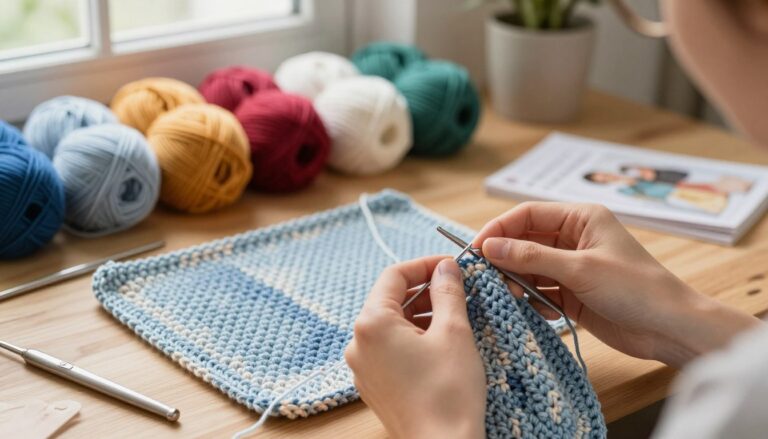
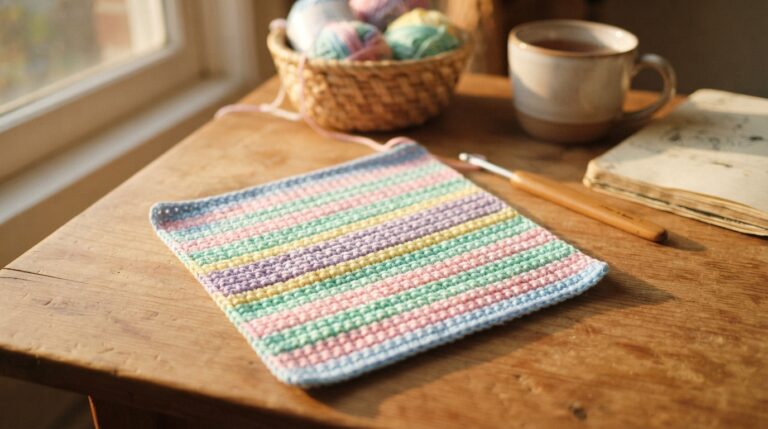
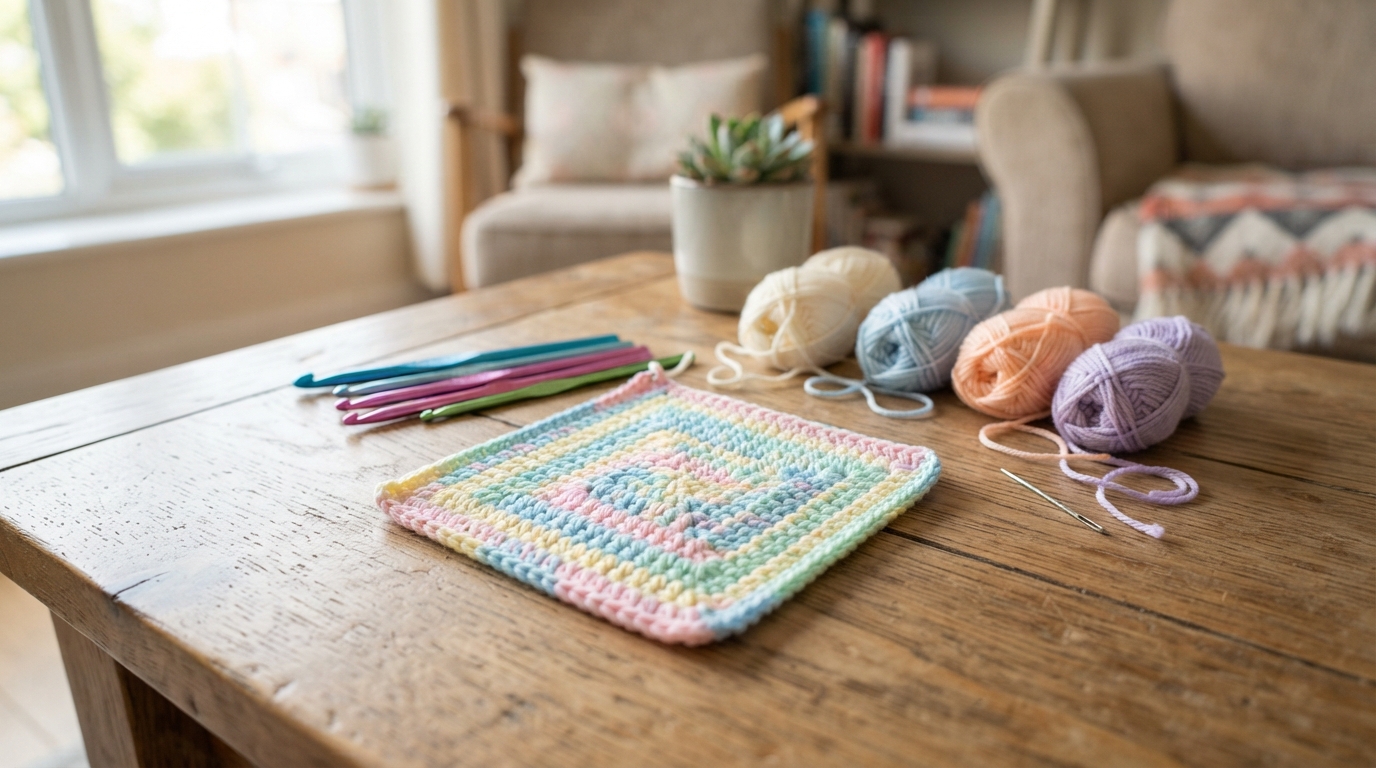
Start with a coaster or practice square, since each uses a simple shape and lets you repeat one stitch. You can see missed or added stitches without managing curves or several parts.
A dishcloth or headband makes a good next step if you want a larger item. Try a scarf when you feel comfortable repeating rows and keeping the length even.
Choose a first crochet project by matching its size to the time and practice you want to give it. Straight edges and one repeated stitch make your early work easier to assess.
Use these beginner crochet ideas to weigh your options:
- Pick a small item if you want to finish quickly.
- Choose a useful household item if you want to practice longer rows.
- Try a scarf if you enjoy repeating the same motion.
Browse more beginner-friendly crochet project ideas if you want to compare simple shapes with wearables and home items.
A common mistake is choosing a shaped toy or fitted garment before you can count stitches. Begin with a rectangle instead, then add new skills one at a time. Once you have a project in mind, gather only the tools it needs.
What Supplies Do You Need to Start Crocheting?
You need a crochet hook, yarn, and scissors to begin; a stitch marker can wait. These simple crochet supplies are enough for a small swatch or flat beginner project.
A yarn label and pattern recommend a hook size. Match them before you start, since crochet hook sizes affect how your fabric feels and measures.
| Item | Essential or optional | What it does | Beginner note |
|---|---|---|---|
| Crochet hook | Essential | Holds and draws yarn loops | Use the size recommended for your yarn and pattern |
| Yarn | Essential | Forms the stitches and fabric | Choose yarn that suits your first project |
| Scissors | Essential | Cuts yarn when you finish | Small sharp scissors are easy to handle |
| Stitch marker | Optional | Marks a stitch or row edge | Helpful, but not needed for a simple swatch |
You may want a yarn needle later for weaving in loose ends. For now, avoid buying several hook sizes before choosing a pattern.
Match the hook to the yarn and instructions first. You can add other tools when a project calls for them, then choose yarn and a hook that work well together.
How Do You Choose Beginner-Friendly Yarn and Hook?
Smooth, light or medium-colored yarn makes individual stitches easier to see. With a clear view of each stitch, you can spot the top loops and count rows more easily.
Which yarn texture makes stitches easiest to see?
Choose a smooth beginner yarn in a light or medium color for early practice. The top loops stand out against the yarn and are easier to find.
Dark yarn can hide the loops, while fuzzy and novelty yarns blur their edges. Chenille feels soft, but its plush surface can make individual stitches hard to see.
How should you match the hook to the yarn?
Worsted-weight yarn is a common starting point, but the yarn label and pattern should guide hook size. An ergonomic crochet hook may feel more comfortable, but its handle is a personal choice, not a requirement.
| Fiber | Beginner-friendly quality | Limitation | Useful choice |
|---|---|---|---|
| Acrylic | Easy-care and widely available | Can feel less soft than wool | Smooth worsted-weight yarn |
| Cotton | Clear stitch definition | Less stretchy than acrylic | Dishcloth or coaster yarn |
| Wool | Soft and elastic | Care needs vary by yarn | Smooth yarn for practice |
| Chenille | Soft, plush feel | Stitches can be hard to see | Save it for later projects |
Choosing dark, fuzzy yarn for early practice is a common mistake. Switch to smooth, light-colored yarn if you keep losing sight of the stitch tops.
After choosing a comfortable pairing, look at the pattern’s yarn, hook, and stitch instructions before you begin.
How Do You Read a Beginner Crochet Pattern?
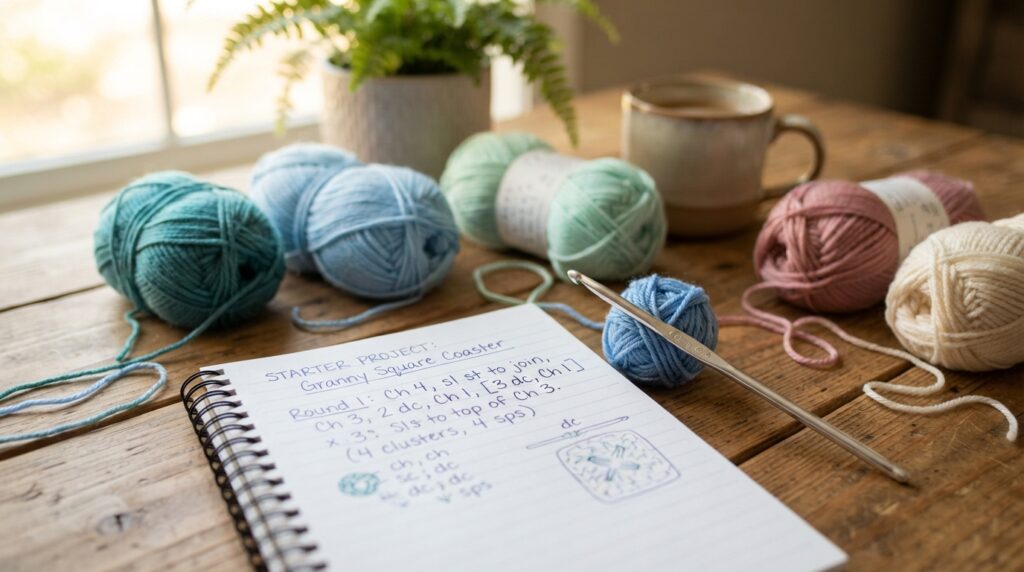
First, identify the pattern’s terminology and instructions instead of guessing from a photo. The materials, stitch names, and row directions tell you what to do.
Check these four details before stitching:
- Check the materials and recommended hook size.
- Identify abbreviations and stitch terms in the pattern key.
- Locate the instructions for each row or round.
- Check whether the turning chain counts as a stitch.
Patterns may use US or UK crochet terms. US single crochet is UK double crochet, while US double crochet is UK treble crochet.
US crochet terms are common in American patterns, but do not assume every pattern follows them. Check the term key before you start.
Assuming UK and US stitch names match can change the height and texture of your work. Confirm the pattern’s terminology first, then move from reading stitch names to learning basic stitches.
Which Crochet Stitches Should You Learn First?
Practice the chain stitch first, then learn single crochet. These basic crochet stitches help you start a fabric and build rows you can count.
How do you make a starting chain?
Hold the slip knot on your hook, with the working yarn behind it. Keep the loop loose enough for the hook to move through.
- Make a slip knot and place it on the hook.
- Yarn over by bringing the working yarn over the hook.
- Pull the yarn through the loop on the hook.
- Repeat the yarn over and pull-through without tightening the chain.
Each pull-through makes one chain stitch. Keep the chain loops loose and similar in size, so you can insert your hook into them later.
What does a single crochet stitch look like?
A single crochet is a short, compact stitch with a small V at the top. In US terms, it is often shortened to sc.
- Insert the hook into the stitch or chain space.
- Yarn over and pull up a loop. You now have two loops on the hook.
- Yarn over and pull through both loops.
For most single crochet stitches, insert under both top loops unless the pattern says otherwise. The V is the top of the stitch; the post is the vertical part below it.
Confusing the top V with the post can lead you to insert the hook in the wrong place. Look for the V along the row before making your next stitch.
Instructional image suggestion: show the hook entering under both top loops of a single crochet. Alt text: “Close-up of a crochet hook inserted under both top loops of a single crochet stitch.”
When should you try half double and double crochet?
Try half double crochet and double crochet after chains and single crochet feel familiar. These taller stitches use extra yarn-over steps and make fabric grow more quickly.
In US terms, half double crochet is taller than single crochet, and double crochet is taller still. UK patterns use different names, so check the pattern key.
Recognizing the V-shaped stitch tops helps you count rows and keep edges straight. From there, steady stitch counts help you work back and forth.
How Do You Keep Stitch Counts and Edges Straight?
Matching the stitch count from row to row is the clearest way to keep a simple rectangle straight. A row that gains or loses stitches can change the shape of your work.
How can you count stitches at the end of each row?
Count each row before turning. Identify the first and last stitch, since those edge stitches are easy to overlook.
Place stitch markers in the edge stitches if they are hard to spot. Markers give you a visible check when you reach the end of the next row.
Adding an edge stitch can widen the piece, while missing the last stitch can narrow it. Check the count before you turn so an error does not carry into more rows.
Does a turning chain count as a stitch?
A turning chain may count as a stitch, or it may not. Follow the pattern’s rule for that stitch and project, rather than treating one rule as universal.
In the single-crochet practice swatch later, chain 1 does not count as a stitch. Each row has 11 single crochet stitches.
Some patterns count a taller turning chain as a stitch, while others do not. The pattern should tell you how to work the first and last stitches around it.
Once you can check row widths, choose a small project that gives you a manageable chance to practice.
Which Beginner Projects Build Skills Gradually?
A coaster lets you practice a chain and single crochet, while a granny square adds working in rounds. The project’s shape affects which skills you practice, even when both items are small.
| Project | Simple materials | Main skills | Approximate first-attempt time |
|---|---|---|---|
| Coaster | Cotton or acrylic yarn, hook | Chain and single crochet | About 1-2 hours |
| Granny square | Yarn and hook | Working in rounds, joining or fastening off | About 1-2 hours |
| Headband | Yarn and hook | Rows and measuring fit | About 2-4 hours |
| Washcloth | Cotton yarn and hook | Even rows and finishing | About 2-4 hours |
| Simple scarf | Yarn and hook | Repeated rows and managing length | About 6-12 hours |
These first-attempt times are approximate, not promises. Pattern complexity, project size, yarn, and your practice pace can all change them.
A granny square introduces working in rounds, so it may feel less straightforward than a rectangle despite its small size. Crochet skill progression works best when you choose one new challenge at a time.
For separate visual browsing, visit HooksyLane on Pinterest. Choose the smallest option that practices the skill you want, then try a guided exercise.
How Do You Make a First Practice Swatch?
A small single-crochet swatch is a useful first exercise because its stitch count stays easy to check. You can repeat the same row and see whether your edges hold their shape.
What materials and setup do you need?
Set out yarn, a hook suited to that yarn, and scissors. Add a stitch marker if one is available; it can help you spot an edge stitch.
This single crochet square uses a chain of 12 and 11 stitches in each row. Keep the working loop on the hook while you count.
How do you work the rows and check the count?
- Chain 12.
- Single crochet in the second chain from the hook and in each chain across. You will have 11 stitches.
- Chain 1 and turn. For this exercise, the turning chain does not count as a stitch.
- Single crochet 11 stitches across each row.
- Repeat for 8-10 rows, counting 11 stitches each time.
- Fasten off and weave in the tail.
Other patterns may count turning chains differently, so follow their own instructions. If a row does not have 11 stitches, undo it before continuing.
A small error is easier to fix before it repeats across several rows. Check the count now, then use common fixes if the swatch starts to change shape.
How Do You Fix Common Beginner Crochet Problems?
If your sample gets wider or narrower from row to row, check for extra or missed edge stitches. The outline often shows a counting problem before the middle of the fabric does.
Why are your edges getting wider or narrower?
An extra stitch at the edge widens each row. Missing the last stitch narrows it. Count the row before turning and use a marker at each edge as a check.
What can you do about tight chains or split yarn?
A tight starting chain can make the next row hard to work. Relax the yarn, or use a slightly larger hook for the chain. Return to the pattern’s recommended hook for the rest.
Use these cause-and-fix pairs when you notice uneven crochet edges or missed stitches:
- Missed edge stitch: Find the last stitch and work into it on the next row.
- Extra edge stitch: Remove the extra stitch, then check the row count again.
- Tight foundation chain: Loosen your yarn or use a slightly larger hook for the chain.
- Splitting yarn: Slow down and catch the full strand with the hook.
Undo a row when its count is wrong instead of adding more rows on top. Once the fabric is corrected, secure it and choose care based on its yarn.
How Do You Finish, Block, and Care for Your Crochet?
Secure loose ends before you handle or wash a finished item. Fastening off and weaving in ends helps keep your stitches from coming loose.
To fasten off, cut the yarn with a tail and pull that tail through the final loop. Thread the tail through a yarn needle, then weave it through nearby stitches.
Blocking crochet means shaping and setting the fabric to improve its finish. The right method depends on the fiber and its care instructions.
Check the yarn label before washing, drying, or applying heat. Acrylic, cotton, and wool may need different care, so do not assume one method suits every project.
Trimming a tail before weaving it in can leave the end loose. Weave it through nearby stitches first, then trim the extra yarn.
With the piece secured and cared for, you can choose a manageable way to practice next.
How Should You Practice After Your First Project?
A short practice session can build consistency before you take on a more complex shape. Repeat a stitch you know, then add one new demand when the work feels steady.
How can you practice without making another full project?
Work a few rows of the same stitch, then stop. Short sessions let you focus on loop size, row edges, and the way your hands hold the yarn.
Make small swatches with the same yarn and hook to compare tension. Keep notes on yarn, hook size, and stitch count so you can repeat a setup that works.
When are you ready to try a more complex shape?
Move from flat rectangles to projects that add one new demand at a time. You might try working in rounds, shaping, or joining separate pieces.
Uneven edges or trouble counting are signs to repeat a simpler swatch, not a reason to abandon crochet. Crochet practice gives you room to improve without committing to a large item.
When your rows stay even and you can follow the pattern’s stitch counts, try one new skill. Use a brief checklist to choose your next step and keep it manageable.
Conclusion
Your first successful step is choosing a manageable item and keeping its instructions within reach. A small project gives you space to learn without having to manage many shapes or parts.
Use this checklist as you begin or continue:
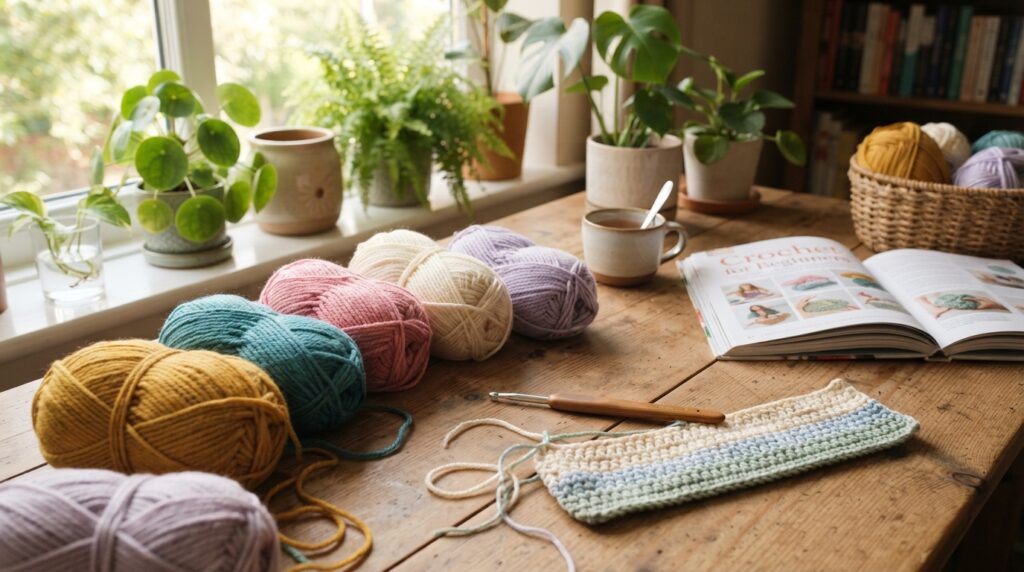
- Choose a simple, flat project.
- Use smooth yarn in a light or medium color.
- Match the hook and yarn to the pattern.
- Count stitches at the end of each row.
- Weave in ends before washing or other care.
Gather yarn and a suitable hook, then make the 12-chain practice swatch if you have not already. Repeating a stitch is part of learning, so take the next row at your own pace.